Marine Paint & Ship Coating Supply in Vietnam
SVC Marine supplies marine coating systems for commercial vessels at Vietnamese shipyards, drydocks, ports and anchorages — antifouling and underwater hull systems for the docking, and ballast and fresh water tanks, cargo holds, deck, accommodation and machinery spaces for dock and afloat work alike.
Send the vessel area, the existing coating, the achievable surface preparation, approximate square metres and the docking or port schedule. We review the coating system, the quantity and the delivery plan against the actual repair work package.
Can SVC Marine Supply Marine Paint to Vessels in Vietnam?
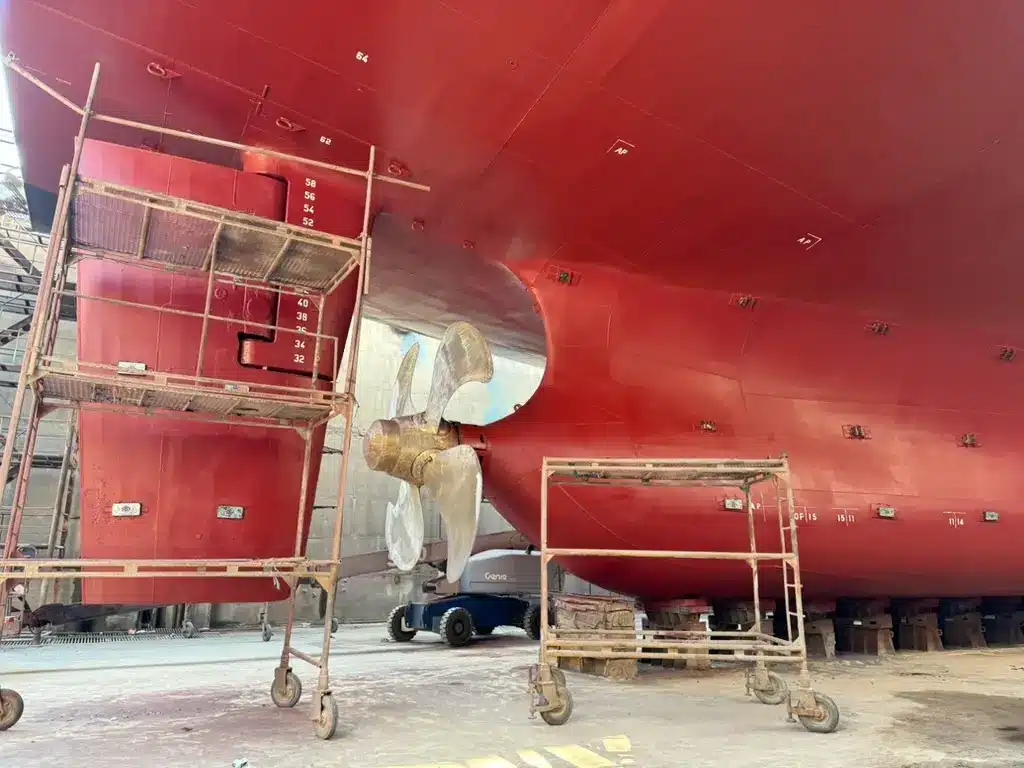
Yes. SVC Marine supplies marine coating systems to commercial vessels at Vietnamese ports, shipyards, anchorages and drydocks, and executes the painting itself on above-water and internal areas while the vessel is afloat. Coating below the waterline is a drydock scope in every case.
Supply covers underwater hull systems, antifouling, zinc-rich and epoxy primers, intermediate coats, tie coats, polyurethane and alkyd topcoats, ballast and fresh water tank coatings, cargo hold coatings, deck and accommodation coatings, machinery-space and heat-resisting coatings, and maintenance touch-up material.
SVC Marine has held agency agreements since 2022 with Chugoku Marine Paints, Nippon Paint Vietnam and New Generation Paint (THM). Supply, invoicing and payment run through SVC Marine at agency pricing plus delivery cost.
Product selection is reviewed against the vessel area, the existing coating, the surface preparation that can actually be achieved on site, the required dry film thickness, the application method, the repair schedule and the applicable manufacturer documentation.
The paint order is reviewed together with the repair work package, not treated as a standalone retail purchase. A coating that arrives after the blasting window has closed stops the entire sequence even when the steel work is already complete.
Drydock and Anchorage Are Not The Same Job
Most coating disputes start here. The same product, the same applicator and the same dry film thickness produce two completely different commercial outcomes depending on where the work is done — because the surface preparation grade that can be achieved is different, and the manufacturer warranty follows the surface preparation grade.
Drydock / Shipyard
Vessel out of waterAnchorage / Afloat
Vessel in the waterBelow the waterline, afloat: cleaning only. Divers remove fouling, clean the hull, polish the propeller and clear fouled ropes and nets. They do not apply coating. Underwater coating repair requires purpose-formulated products, certified underwater applicators and a port permission that is rarely granted, and even then it does not reinstate the hull system.
Underwater cleaning removes fouling. It does not restore a coating. Where an inspection records coating breakdown, exposed steel or blistering below the waterline, that finding is an input to the drydock coating scope — the affected area, the extent and the photographic evidence feed the paint specification and the quantity. It is not a job that can be closed out at anchorage. See Underwater Inspection & Hull Cleaning.
Boundary — Repair Is Not A New System
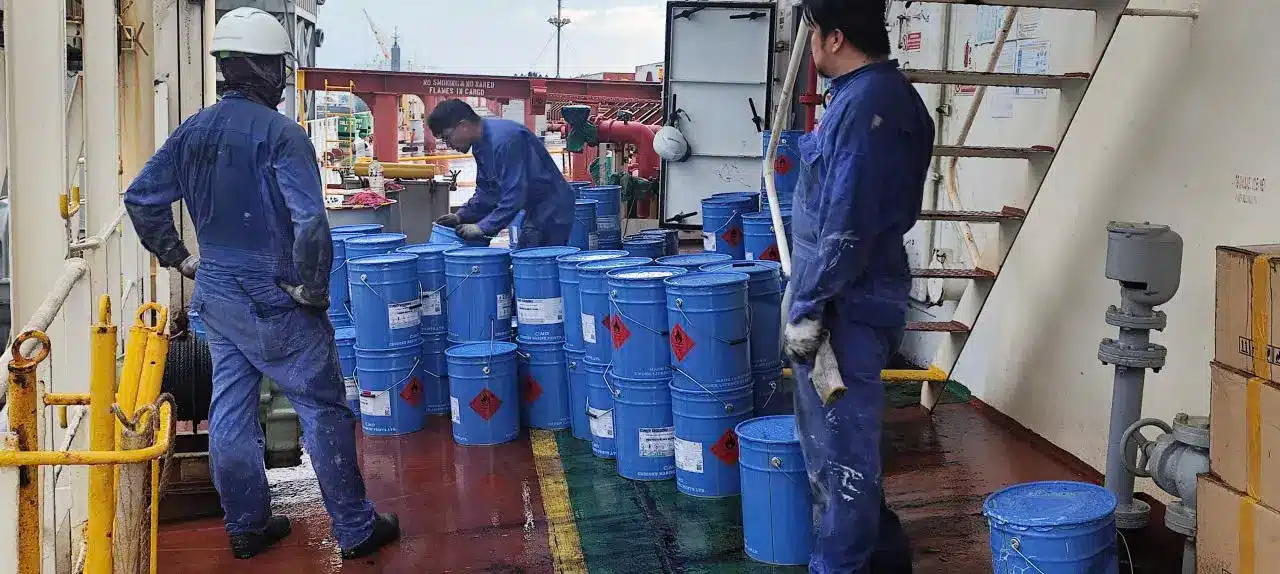
Anchorage maintenance painting is presented to the owner as localised corrosion repair with a defined service expectation until the next scheduled docking. It is not a full coating system, it does not restore the original specification, and no manufacturer warranty attaches to it. Anyone offering a warranted hull coating at anchorage is describing something that cannot be executed.
Supply and onboard work at anchorage remain subject to vessel procedures, weather, port and anchorage requirements, launch access and environmental controls.
Marine Paint Is A Coating System, Not A Colour
A product suitable for deck maintenance can be entirely unsuitable for permanent seawater immersion, for a ballast tank or for a cargo hold carrying abrasive bulk. Selection runs down a chain, and every link is set by the vessel, not by the catalogue.
Coating Systems By Vessel Area
The table below is the New Generation Paint (THM) marine system as published in the manufacturer’s 2026 catalogue, separated into sea-going and river service. Codes and dry film thicknesses are reproduced from that document without alteration.
| Vessel area | Coat | Coating type | Sea service | River service | DFT (µm) |
|---|---|---|---|---|---|
| Bottom + Anchor | 1 | Zinc-rich epoxy primer | ET1601 | ET1601 | 60 – 70 |
| 1 | Epoxy primer | EH1602, EI1602 | EI1602 | 80 – 140 | |
| 2 | Epoxy intermediate coat | EH2104, EH2101, EI2103 | EI2103, EI2203 | 80 – 140 | |
| 3 | Epoxy topcoat | — | Epoxy topcoat range | 80 | |
| 3 | Epoxy tie coat | EC2101 | — | 50 – 60 | |
| 4 + 5 | Antifouling | AF3152 | — | 80 – 120 | |
| Boot Top | 1 | Zinc-rich epoxy primer | ET1601, EH1601 | ET1601, EH1601 | 60 – 70 |
| 1 | Epoxy primer | EH1602, EI1602 | EI1602 | 80 – 140 | |
| 2 | Epoxy intermediate coat | EH2104, EH2101, EI2103 | EI2103, EI2203 | 80 – 140 | |
| 3 | PU topcoat | PU topcoat range | PU topcoat range | 50 – 60 | |
| Deck + Hatch Coaming + Inner Bulwark | 1 | Epoxy primer | EH1602, EI1602 | EI1602 | 80 – 140 |
| 2 | Epoxy intermediate coat | EH2104, EH2101, EI2103 | EI2103, EI2203 | 80 – 140 | |
| 3 | PU topcoat | PU topcoat range | PU topcoat range | 50 – 60 | |
| Accommodation / Cabin | 1 | Epoxy primer | EH1602, EI1602 | EI1602 | 80 – 140 |
| 2 | Epoxy intermediate coat | EH2104, EH2101, EI2103 | EI2103, EI2203 | 80 – 140 | |
| 3 | PU topcoat | PU topcoat range | PU topcoat range | 50 – 60 | |
| Structural Steel | 1 | Epoxy primer | EH1602, EW1602, EI1602 | EI1602, EW1602 | 80 – 100 |
| 1 | Advanced alkyd topcoat | AMC1602, AMC1101 | AMC1602, AMC1101 | 60 – 70 | |
| 2 | Epoxy topcoat | Epoxy topcoat range | Epoxy topcoat range | 80 | |
| 2 | Advanced alkyd topcoat | Advanced alkyd range | Advanced alkyd range | 40 – 60 | |
| Fresh Water Tank | — | Food-grade epoxy coating | ES3690 | ES3690 | 3 × 100 |
Manufacturer’s note, reproduced as published: coating codes are for reference only and may be replaced with equivalent products of comparable quality and performance. Topcoat ranges shown without a code are quoted against the specific colour and gloss required. The system is declared free of hazardous heavy metals and compliant with QCVN 08:2020/BCT, QCVN 64:2015/BGTVT, QCVN 74:2014/BGTVT, the AFS 2001 Convention and IMO requirements. Manufacturer certifications include a VILAS 1124 laboratory accredited to ISO/IEC 17025:2017, ISO 9001:2015, ISO 14001:2015, ISO 45001:2018, and coating system conformity to ISO 12944 C4 and C5-High.
Antifouling For Commercial Vessels
Two antifouling routes are available through SVC Marine, and they are different technologies with different film builds. They are quoted separately and never specified interchangeably.
AF3152 — In-system antifouling
Quoted as part of a complete bottom system rather than as a standalone drum, because the tie coat and the intermediate build below it determine whether the antifouling performs at all.
AF1000 — Biocide-free silicone
Manufacturer’s stated performance for AF1000 is fouling control of up to 10 years, protection of the hull with no release of copper(I) oxide or algaecide, and reduced fuel consumption. Service life achieved on any specific vessel depends on trading pattern, idle periods, achieved surface preparation and applied film thickness, and is confirmed against the current product data sheet before order.
Boundary — Shelf Life Drives The Order Date
AF1000 carries a stated shelf life of six months from the date of manufacture. On a docking that slips by a quarter, material ordered too early expires before it is opened. Antifouling is scheduled against the confirmed dock date and the blasting programme, not against the date the purchase order was raised.
Ballast Tanks, Fresh Water Tanks And Cargo Holds
Ballast tank coating
Permanent seawater immersion, restricted access, and edges, welds and stiffener faces that need stripe coating before the main coats go on. Within the Nippon Paint Vietnam range:
- PSPC service: NOA 60HS · E-Marine 2000
- Non-PSPC service: Hi-Pon 20-04 STE IM 80 with a glass-flake epoxy, grade confirmed against the current data sheet at quotation
The Type Approval Certificate and the documentation supporting the Coating Technical File are issued by the coating manufacturer and supplied with the order.
Fresh water tank coating
Food-grade epoxy ES3690, specified at three coats of 100 µm. Potable water service is the one area where substitution on price is not available — the coating either holds the certification for potable contact or it does not.
Cargo hold coating
Abrasion, grab impact, cargo residue, wash-down and corrosion under residue. Selection depends on the commodity carried, the condition of the existing coating and the resistance required.
Resistance to a specific commodity is confirmed against the manufacturer documentation for the product proposed. It is never assumed from the generic coating type.
Boundary — Enclosed Space Entry
Cargo hold and ballast tank work at anchorage is enclosed-space work carried out away from a shipyard. Entry proceeds under the vessel’s own permit-to-work system, following gas-freeing, atmosphere testing, continuous ventilation, a standby attendant and rescue arrangements. SVC Marine does not enter a tank or hold on verbal clearance and does not certify a space as safe for entry — that remains the Master’s responsibility.
Solvent-borne coatings applied inside a tank raise the ventilation requirement above the level needed for entry alone. Ventilation capacity is agreed before the coating is ordered, not after the drums are on deck.
Machinery Spaces, Heat-Resisting And Structural Steel Coatings
Protective coatings from the Nippon Paint Vietnam range, used for engine room steel, machinery foundations, pump-room steel, pipe supports, tank linings, and new or repaired steel after renewal. Volume solids below are as published in the manufacturer’s company profile, stated there as updated to April 2022 — the current data sheet is confirmed at quotation before any quantity is calculated from these figures.
| Classification | Generic type | Product | Volume solids (%) |
|---|---|---|---|
| Shop primer | Epoxy | Hi-Pon 20-09 Epoxy Shop Primer FD | 30 |
| Primer | Inorganic zinc rich | Zinky-12 Inorganic Zinc Rich Primer | 65 |
| Epoxy zinc rich | Zinky-22 Epoxy Zinc Rich Primer 80 | 65 | |
| Epoxy red oxide | Hi-Pon 20-01 Epoxy Primer | 73 | |
| Epoxy zinc phosphate | Hi-Pon 20-07 Epoxy Zinc Phosphate 70 | 72 | |
| Intermediate | Epoxy mastic | Hi-Pon 20-04 STE 80 | 80 |
| Epoxy micaceous iron oxide | Hi-Pon 30-02 Epoxy MIO 80 | 80 | |
| Epoxy mid coat | Hi-Pon 30-06 Epoxy MidCoat 90 | 90 | |
| Topcoat | Polyurethane | Hi-Pon 50-01 Polyurethane Top Coat | 60 |
| Fluorocarbon | Hi-Floro 6738 FloroCarbon Top Coat | 48 | |
| Tank lining | Phenolic epoxy | Hi-Pon 80-03 Epoxy Phenolic Primer | 65 |
| Phenolic epoxy | Hi-Pon 80-04 Epoxy Phenolic Top Coat | 65 | |
| Coal tar epoxy | Epoxy | 1226 Epotar HB Black | 58 |
| Heat resistant | Silicone primer | Nippon S500 Heat Resisting Primer | 49 |
| Silicone topcoat | Nippon S450 Heat Resisting Black | 46 | |
| Silicone topcoat | Nippon S350 Heat Resisting Aluminium | 38 |
Temperature limits, pot life, mixing ratio, recoat intervals and thinner type are not reproduced here. Those figures are product-specific and are supplied from the current technical data sheet with the quotation. Temperature resistance is never inferred from the words “heat resisting” in a product name.
Coating Supply After Steel Renewal
Insert plates, bulkhead and deck repairs, pipe supports and hatch coaming repairs all leave bare, freshly welded steel that has to be primed inside the recoat window while the yard is still mobilised. Coating supply is scheduled against the steel programme, which is why the paint order and the steel worklist are reviewed together. See Steel Repair & Hot Work in Vietnam.
Marine Coating Brands Available Through SVC Marine
Three agency agreements, one commercial counterparty. Supply, invoicing and payment run through SVC Marine at agency pricing plus delivery cost. The brand is selected against the specification and the achievable surface preparation — not against whichever agency happens to carry the better margin.
Japanese marine and offshore coating manufacturer, supplied through the agency for newbuilding, drydock and afloat maintenance requirements.
Specific product names, coating system data and technical values are not published on this page, and are quoted from the manufacturer’s current documentation against a stated vessel and specification.
Manufacturing in Vietnam since 1994, with plants in Dong Nai, Hanoi and Vinh Phuc, certified to ISO 9001, ISO 14001 and ISO 45001.
Used for protective and heavy-duty ranges — zinc-rich and epoxy primers, epoxy mastic and MIO intermediates, polyurethane and fluorocarbon topcoats, phenolic epoxy tank linings and heat-resisting silicone systems — as well as ballast tank and antifouling requirements.
Vietnamese manufacturer established in 2007, with a VILAS 1124 laboratory accredited to ISO/IEC 17025:2017 and coating system conformity to ISO 12944 C4 and C5-High.
Competitive local supply for coastal and river fleets, barges and workboats, with a published system table covering bottom, boot top, deck, accommodation, structural steel and fresh water tanks, and Vietnam Register works approval for anti-fouling manufacture.
Surface Preparation, Dew Point And Film Thickness
Coating failures are far more often a preparation and application problem than a product problem. Salt contamination left on the steel, coating applied within three degrees of the dew point, or a stripe coat skipped on edges and welds will defeat any product in the catalogue.
Cleaning and washing
Oil and grease removed with a suitable cleaner, followed by high-pressure fresh water washing. Salt is measured, not assumed to be gone.
Preparation grade
Sa 2½ to ISO 8501-1 in dock. St 2 to St 3 afloat. The grade is recorded as what was achieved, not as what the specification asked for.
Application window
Surface temperature, ambient temperature, relative humidity and dew point checked against the product data sheet before each coat and logged.
Film thickness
Wet film checked during application, dry film after cure. Stripe coats on edges, welds and cut-outs applied before the main coat.
Coating Quantity Planner
Enter the figures from the data sheet for the product actually being quoted. Theoretical spreading rate is volume solids × 10 ÷ target DFT. Wet film thickness is target DFT ÷ volume solids fraction. Nothing here is pre-loaded from a product database, because a spreading rate carried across from a different product is the most common way a paint order comes up short.
Boundary — Planning Figure, Not An Inspection Result
The planner output is for procurement planning only. Final quantity must account for actual surface profile and condition, geometry, edges, welds and stripe coating, application method, overspray and the applicator’s own allowance. The loss allowance is entered by the user and is not proposed by SVC Marine.
SVC Marine supplies coating and executes application within its scope. SVC Marine is not the coating manufacturer, and does not act as a certified coating inspector issuing DFT or surface-preparation certification unless separately appointed in writing for that role.
What Voids The Coating Warranty
Reproduced from the manufacturer’s published warranty policy so it is on the table before the order, not after the failure.
What the warranty actually covers
- Underwater hull areas only. Deck, topside, tank and cargo hold coatings are outside its scope.
- It responds to blistering affecting more than half the underwater hull area, together with delamination, arising from a manufacturing defect.
- New vessels and barges: a three-year docking threshold. Repaired vessels and barges: a two-year threshold. Inside the threshold the manufacturer covers replacement coating for coats 1, 2 and 3 plus the application cost for the affected area; beyond it, replacement coating only.
- Damage from mechanical impact, collision, abrasion or heavy objects is excluded.
This is a manufacturing-defect warranty, not a service-life guarantee. Read it that way when it is quoted to you by anyone.
The technical conditions that must be met
- Oil and grease removed with a suitable cleaner, followed by high-pressure fresh water washing.
- Abrasive blast cleaning to Sa 2½ per ISO 8501-1.
- Application carried out only with the approval of the coating manufacturer.
- The recommended coating system followed, with the specified number of coats and dry film thickness achieved.
Miss any one of these and the warranty does not respond. This is precisely why anchorage work carries none: Sa 2½ cannot be achieved on a floating vessel, and the underwater hull — the only area the warranty covers — cannot be painted afloat at all.
Marine Paint Supply For Drydock Projects In Vietnam
A docking runs several coating systems at once across different areas, on a sequence that cannot be re-ordered. Paint arriving late stops the whole chain even when the steel and blasting are already finished.
Specification received
Vessel, yard, docking dates, approved coating specification and the existing system on board.
Surface area
Square metres by area, repair areas, new steel, full coat against touch-up.
Preparation grade
Blasting, power-tool cleaning, washing, spot preparation — confirmed with the yard, not assumed.
System selection
Primer, intermediate, tie coat, finish and antifouling matched to the existing coating.
Quantity
Volume solids, target DFT, coat count and spreading rate from the data sheet, with the applicator’s allowance confirmed.
Delivery schedule
Phased against blasting completion, steel work and the coating sequence — including antifouling shelf life.
Documentation
Technical data sheets, safety data sheets and the coating schedule issued to the vessel and the yard.
Delivery and attendance
Delivery to yard or vessel, and attendance during application where SVC Marine is appointed.
Painting Sequence Must Fit The Docking Schedule
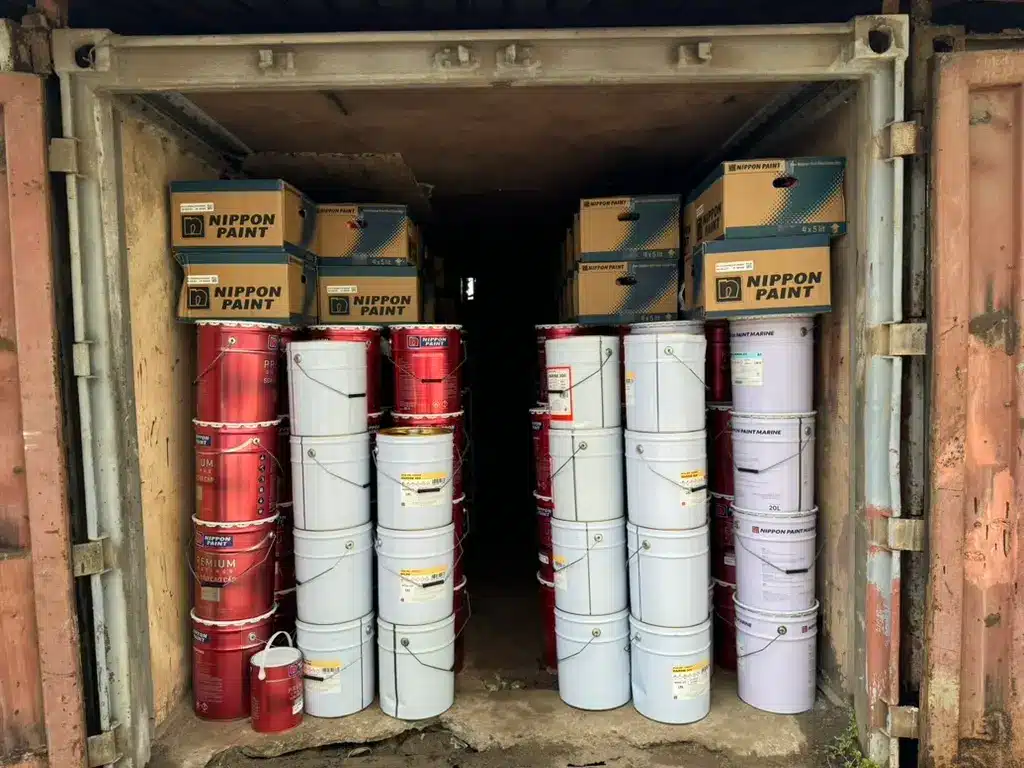
Surface temperature, ambient temperature, humidity, coating temperature, minimum and maximum recoat intervals and the required time before immersion all constrain this sequence. The values used are those in the data sheet for the product actually applied. Where SVC Marine attends, the sequence is recorded against the docking programme — see Drydock Supervision in Vietnam.
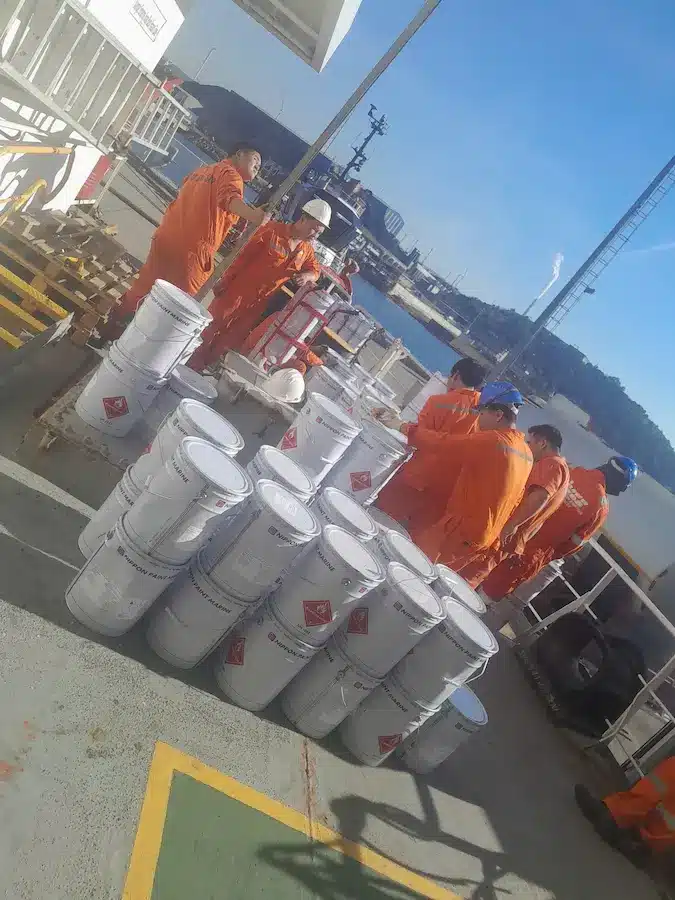
Send The Coating Specification
A quotation that is worth comparing needs the same inputs every time. Send what you have — an incomplete requisition is still better than a drum count with no vessel attached.
Vessel & project
- Vessel name, IMO, type, class, flag
- Port, shipyard or anchorage
- ETA and docking dates
- Project contact
Scope & condition
- Areas: hull, boot top, topside, deck, cargo hold, ballast tank, fresh water tank, engine room, repair areas
- Existing brand and product if known, and when last applied
- Photographs of the current condition
- Surface preparation available: blasting, mechanical, new steel
Quantity & documents
- Approximate square metres by area
- Required coats and specified DFT
- Requested system, product and package size
- Paint specification, coating plan, docking worklist, current paint list
- Whether TDS and SDS are required
Send to shipchandler@svcmarine.com with the subject line Marine Paint Requisition — Vessel / IMO.
Pricing is quoted against the product, vessel area, quantity, package size and delivery location. No retail price list is published. For drydock and larger repair packages, coating is planned as one procurement rather than a series of emergency purchases at port.
Marine Paint Supply — FAQ
Does SVC Marine supply marine paint to vessels in Vietnam?
Yes. SVC Marine supplies marine coating systems to commercial vessels at Vietnamese ports, shipyards, anchorages and drydocks. Supply may cover underwater hull systems, antifouling, primers, intermediate coats, ballast and fresh water tank coatings, deck and superstructure coatings, machinery-space coatings and maintenance touch-up products, subject to the vessel specification and current availability.
Which marine coating brands does SVC Marine hold agency for?
SVC Marine has held agency agreements since 2022 with Chugoku Marine Paints, Nippon Paint Vietnam and New Generation Paint (THM). Supply, invoicing and payment run through SVC Marine at agency pricing plus delivery cost. The correct brand for a given job is selected against the vessel specification, the existing coating and the achievable surface preparation, not against a preferred supplier.
Can SVC Marine supply antifouling paint?
Yes. Two antifouling routes are available. AF3152 sits as coats 4 and 5 of the New Generation Paint sea-going bottom system at 80 to 120 microns dry film thickness. AF1000 is a separate biocide-free silicone product applied as a single coat at 20 to 30 microns over a cured epoxy system. The two products are different technologies with different film builds and are never specified interchangeably. Nippon antifouling is also available through the Nippon Paint Vietnam agency.
Can SVC Marine supply a complete drydock coating package?
Yes. A drydock package is quoted as one procurement against the approved coating specification and the docking worklist, covering primers, intermediate coats, tie coats, antifouling, topcoats, tank coatings and touch-up material, with delivery phased against blasting and steel-renewal progress rather than delivered as a single early drop.
Does the manufacturer warranty apply to painting carried out at anchorage?
No. The New Generation Paint warranty applies to underwater hull areas only, and its technical conditions require degreasing, high-pressure fresh water washing and abrasive blast cleaning to Sa 2½ per ISO 8501-1, with application approved by the manufacturer and the specified system, coat count and dry film thickness achieved. Afloat at anchorage there is no blast enclosure and no dew-point control, so the achievable standard is hand or power tool cleaning to St 2 or St 3. Anchorage work is localised repair intended to extend coating life. It is not a new coating system and it carries no manufacturer warranty.
Which areas can SVC Marine actually paint at anchorage?
Topsides and freeboard above the waterline, decks, hatch coamings, accommodation and superstructure, cargo holds and ballast tanks. Bottom, boot-top and sea chests are drydock scope.
Can SVC Marine supply ballast tank coating compliant with IMO PSPC?
SVC Marine supplies the coating. Within the Nippon Paint Vietnam range the systems designated for PSPC service are NOA 60HS and E-Marine 2000, and a non-PSPC alternative is Hi-Pon 20-04 STE IM 80 with a glass-flake epoxy. The Type Approval Certificate and the documentation supporting the Coating Technical File are issued by the coating manufacturer and supplied with the order. SVC Marine does not issue approvals and does not sign the Coating Technical File.
Can SVC Marine calculate paint quantity from square metres?
SVC Marine can produce a theoretical quantity using the volume solids and target dry film thickness stated in the product data sheet for the specific product being quoted. The result is a planning figure. Actual consumption depends on surface profile, geometry, edges and welds, stripe coating, application method, overspray and the contractor allowance, and the practical allowance is confirmed by the applicator.
Can different coating brands be mixed in one system?
Not by default. Overcoating an unknown or foreign coating requires review of the existing generic type, its condition, solvent sensitivity, adhesion and the recoat window. Where the existing coating cannot be identified from records, a test patch or additional inspection may be appropriate in line with the manufacturer guidance for the product proposed.
Can SVC Marine supply cargo hold coating?
Cargo hold coating is supplied against the specification provided. Selection depends on the cargo carried, the condition of the existing coating and the abrasion and chemical resistance required. Resistance to a specific commodity is confirmed against the manufacturer documentation for the product proposed, not assumed from the coating type.
Can SVC Marine provide TDS and SDS?
Yes, where the manufacturer has issued them for the selected product. Data sheets are sent by email against a stated vessel and enquiry. They are not published for download, because several manufacturers restrict republication of safety data sheets.
Does SVC Marine guarantee coating performance?
No. Coating performance depends on product selection, substrate condition, surface preparation, application method, ambient and surface temperature, humidity and dew point, achieved dry film thickness, curing and service condition. Any performance warranty is issued by the coating manufacturer under its own terms.
Coating Procurement Connected To The Repair Work Package
Supplying drums is the easy part. The value is in the coating arriving in the right quantity, at the right point in the sequence, on a job SVC Marine is already attending.